If you are planning a concrete patio this year, the first question is almost always the same: what is the concrete patio cost in Dallas, and why do quotes for similar-looking backyards vary so much? The short answer is that concrete patio prices are built from a handful of decisions and site conditions, and in North Texas a few of them carry more weight than they do elsewhere.
This guide walks through how contractors price a patio, how each finish affects the cost, the Dallas-specific factors that move the number up or down, and how to compare estimates so you know exactly what you are paying for.
Quick answer: The cost of a concrete patio in Dallas depends on five main things: the size and shape of the patio, how much site preparation the yard needs, the slab thickness and reinforcement, the finish and color you choose, and any add-ons such as steps, seat walls, or a fire pit. Because those factors change from yard to yard, the only reliable price is an itemized, on-site estimate from a local patio contractor.
How Much Does a Concrete Patio Cost? Why There Is No Single Price
Online calculators and national concrete patio prices are a useful starting point, but they rarely match a real Dallas backyard. They cannot see your slope, your soil, the old slab that needs to come out, or the narrow side gate a crew has to work through. Two patios with the same square footage can land at very different prices for reasons that are invisible in a photo.
That is why the most useful way to think about cost is as a set of building blocks. Once you know what each block is and why it matters, you can read any estimate, spot what is missing, and decide where you want to invest and where you can simplify.
How Concrete Patio Cost per Square Foot Is Calculated
When you ask about the cost to pour a concrete patio, most patio contractors quote a price per square foot, then add separate line items for work that does not scale neatly with size. Understanding that split helps you compare quotes fairly.
What is usually included in the per-square-foot price
- Forming the patio shape and setting the grade
- The concrete itself, delivered and placed
- Standard reinforcement (wire mesh or rebar)
- A basic finish, such as a broom texture
- Control joints to guide natural cracking
What is often priced separately
- Removing and hauling away an old slab, grass, or pavers
- Excavation and grading on sloped or uneven yards
- Extra base material, heavier reinforcement, or thicker slab areas
- Decorative finishes, color, borders, and sealing
- Steps, seat walls, fire pit pads, and lighting conduit
- Drainage work, permits, and HOA paperwork
Size matters in a less obvious way, too. Every project carries fixed costs for the site visit, crew and equipment mobilization, concrete delivery, and cleanup. On a small patio those costs are spread across fewer square feet, so the cost per square foot is usually higher than on a large patio, even when the total project price is lower.
How patio size changes the total
Square footage is the biggest driver of the total. A 10×10 patio covers 100 square feet, a 20×20 covers 400, a 15×30 covers 450, and a 20×40 covers 800. Doubling the area roughly doubles the concrete, labor, and finishing time, but not the fixed costs, so larger patios cost more overall while costing less per square foot. If you are unsure what size you need, think about how you will use the space: a bistro table and two chairs fit on a small pad, while a dining set, grill, and lounge seating usually call for 300 square feet or more.
Cost by Patio Finish
The finish is where most of the price range in a concrete patio comes from. A plain broom finish needs the least labor and time. Every step up in texture, color, or pattern adds materials, crew size, or finishing time. The table below compares the most common patio finishes by relative investment, from the most budget-friendly to the most involved.
| Finish | Relative Investment | What Drives the Cost | Best For |
| Broom finish | Entry level | Simplest finishing step; minimal labor | Everyday patios, tight budgets |
| Broom finish + integral color | Low to moderate | Color added to the mix at the plant | Matching brick or trim affordably |
| Exposed aggregate | Moderate | Extra washing step with precise timing | Natural look, strong grip |
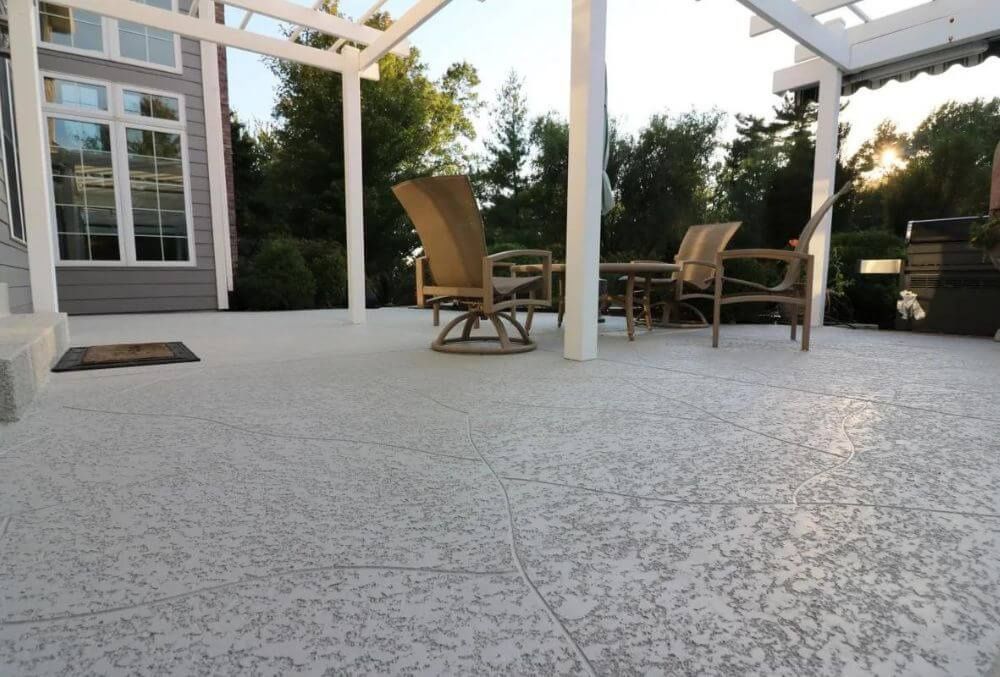
| Knockdown texture | Moderate | Hand-applied texture layer over the slab | Full-sun yards, poolside areas |
| Stained or surface color | Moderate to higher | Extra coloring and sealing steps | Covered patios, rich color |
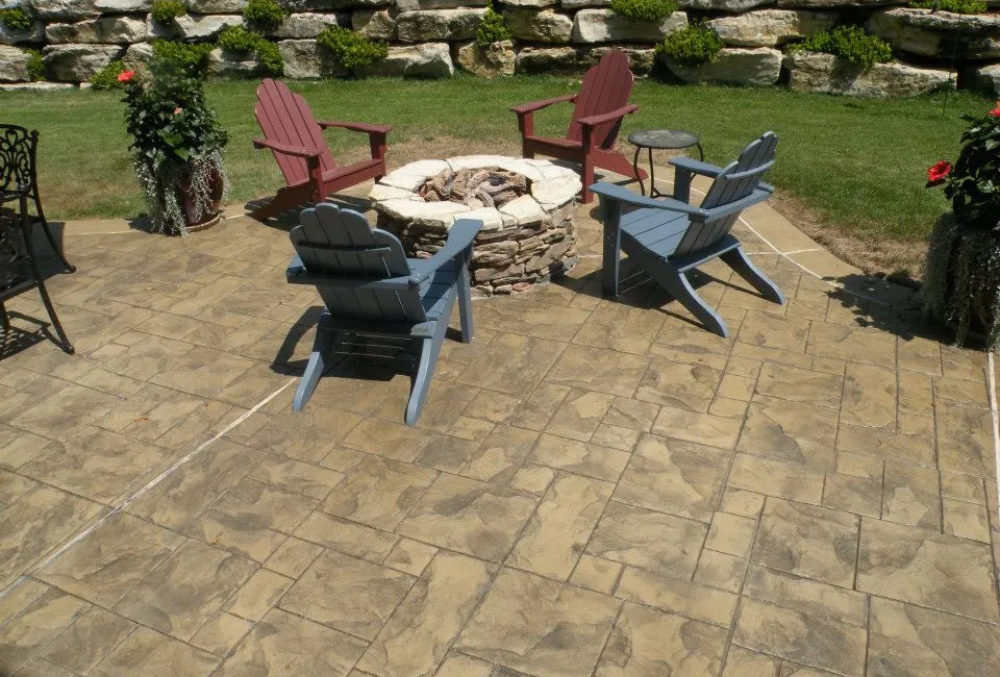
| Stamped pattern | Higher | Stamp mats, release color, larger crew, tight timing | Stone, brick, or wood look |
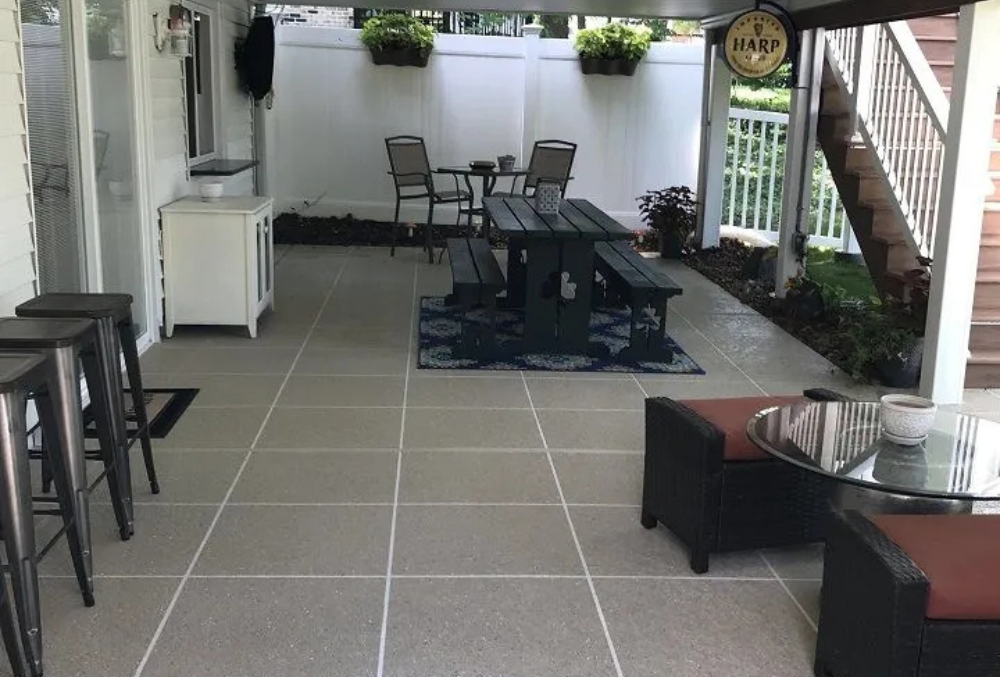
| Polyaspartic coating | Higher | Surface prep plus a multi-coat system | Covered patios, outdoor kitchens |
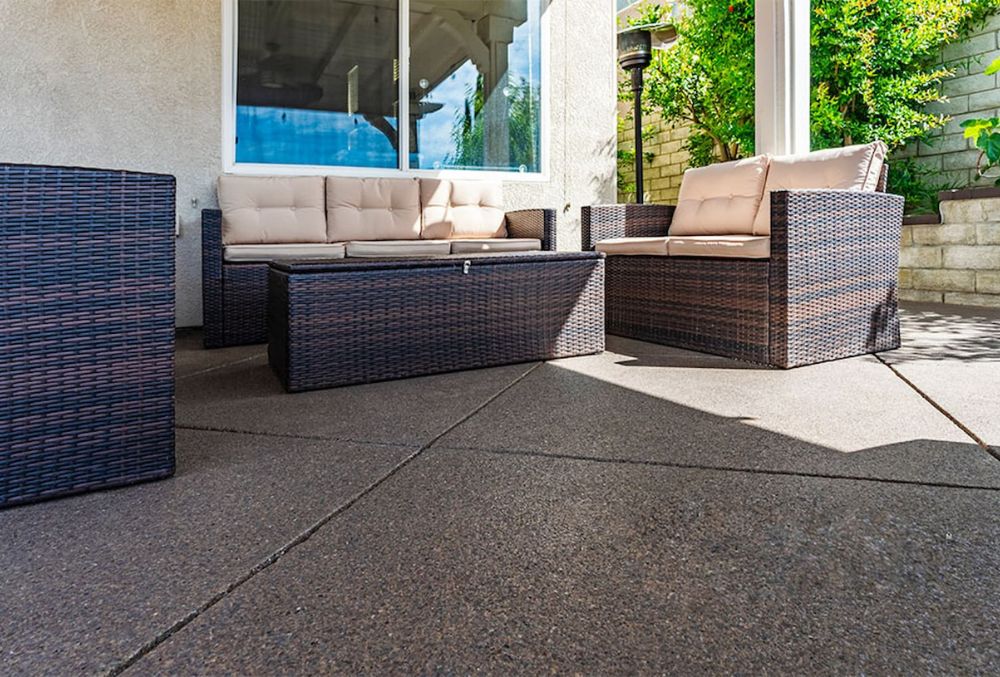
A few notes help put the table in context. Adding integral color to a broom finish is one of the best-value upgrades, because the color runs all the way through the slab and does not wear off. A light-colored knockdown texture costs more than a plain finish but stays cooler underfoot in July, which many Dallas homeowners consider worth it around pools and in full-sun yards. For covered patios and outdoor kitchens, a polyaspartic coating adds stain resistance and an easy-to-clean surface.
Dallas-Specific Factors That Affect Concrete Patio Cost
This is where a Dallas patio differs from a national cost guide. Local soil, weather, and lot layouts all show up in the final number.
Expansive clay soil
Much of the Dallas area sits on clay soil that swells when it gets wet and shrinks when it dries out. That movement is the main reason patios crack and settle in North Texas. Contractors offset it with a properly compacted base, good drainage, and stronger reinforcement, often rebar instead of light wire mesh. These steps add to the cost, but skipping them is the most expensive mistake a homeowner can make.
Slope and drainage
Every patio needs to slope away from the house so water does not pool against the foundation. A flat, well-drained yard needs little extra work. A yard that slopes toward the home, or one that already holds water after storms, may need regrading, a French drain, or a step-down design, all of which add to the scope.
Texas heat and pour timing
Concrete sets quickly in Dallas summers. Crews often start very early in the morning, adjust the mix, and take extra curing steps to prevent surface cracking. On larger or decorative patios, that can mean a bigger crew working against the clock. Heat does not make a summer patio a bad idea, but it is part of why an experienced crew matters.
Site access
Many Dallas homes have fenced backyards with a single gate or alley access. If a concrete truck can pull close to the patio, the pour is straightforward. If it cannot, the crew may need a pump truck or extra labor to move concrete into place. Trees, pools, and landscaping between the street and the patio can also slow the work.
Removing an old patio
Breaking out an old slab, hauling it away, and preparing the ground underneath can be a significant part of the job. If your existing patio is structurally sound and drains correctly, it may not need to come out at all. In that case, it is worth asking whether you can refresh a patio without tearing it out instead.
Permits, HOAs, and utility lines
Permit requirements vary by city across the metroplex, and many neighborhoods in Plano, Frisco, McKinney, and other suburbs have HOA rules on patio size, setbacks, and materials. Your contractor should also have underground utilities marked through Texas811 before digging. Approval time and paperwork are small costs, but they affect scheduling.
Add-Ons That Change the Cost of a Concrete Patio
Add-ons are where a basic slab becomes an outdoor living space. Each one adds scope, so it helps to decide early which ones you want now and which can come later.
- Steps and multiple levels: connecting the patio to a raised back door or a sloped yard adds forming and finishing work.
- Curves and custom shapes: free-form edges take longer to form than a simple rectangle.
- Decorative borders and bands: a contrasting border is an affordable way to make a simple patio look custom.
- Seat walls and fire pit pads: built-in seating and fire features need extra concrete and reinforcement.
- Outdoor kitchen areas: countertops and appliances need a thicker, reinforced section of slab.
- Patio covers and pergolas: footings for posts should be planned before the pour, even if the cover is added later.
- Lighting and power conduit: running conduit under the slab before the pour costs far less than cutting into it afterward.
- Sealing: a quality sealer protects color and resists stains, and it should be resealed every few years.
How to Keep Your Patio Within Budget
A great patio does not need every upgrade. A few smart choices keep the cost of a concrete patio under control without hurting how long it lasts.
- Keep the shape simple. A clean rectangle or L-shape costs less to form and finish than sweeping curves.
- Choose color over pattern. Integral color with a broom finish and a decorative border delivers a custom look for less than a complex pattern.
- Plan in phases. Pour the main patio now and leave room to extend it or add a fire pit later.
- Do not cut base prep or reinforcement. These are the steps that protect your investment from Dallas clay.
- Ask about refreshing an existing slab. If your current patio is sound, an overlay or coating may cost less than a new pour.
For more ways to stretch your patio budget, see these budget-friendly decorative patio ideas for Dallas families. If you are working with limited space, these layout ideas for small Dallas backyards show how to get the most out of every square foot.
How to Compare Concrete Patio Quotes in Dallas
When estimates come back far apart, the difference is almost always in what is included, not in the price of the concrete. Use these questions to compare quotes line by line:
- What slab thickness and base depth are included?
- Is the reinforcement rebar or wire mesh, and how is it spaced?
- Does the price include demolition, haul-off, and grading?
- How will the patio drain, and is any drainage work included?
- Which finish, color, and sealer are included, and when should it be resealed?
- Who handles permits and HOA approvals?
- What is the payment schedule, and what does the warranty cover?
Be cautious of a quote that is much lower than the rest. It often means a thinner slab, less base, lighter reinforcement, or no sealing, which shows up later as cracks and settling.
Why the Best Price Comes from an On-Site Estimate
Every number in a patio quote depends on conditions that can only be confirmed in person: the soil, the slope, the access, the old slab, and how you plan to use the space. An on-site estimate lets a contractor measure accurately, spot drainage issues before they become problems, and show you finish samples so you can see how each option changes the price.
Asking the patio company directly also gives you something a national average cannot: a written, itemized price for your yard, with clear options to add or remove features until it fits your budget. Before you decide, browse our concrete patio projects to see the finishes and layouts in real Dallas backyards.
Get a Free Concrete Patio Estimate in Dallas
Ready to find out what your concrete patio will cost in Dallas? Dallas Decorative Concrete builds custom patios across the Dallas–Fort Worth area, from simple broom-finish slabs to full outdoor living spaces. We will visit your property, talk through your goals, and give you a clear, itemized estimate with no surprises. Call (972) 808-5281 or request a free estimate online.
Frequently Asked Questions About Concrete Patio Cost
Is a concrete patio cheaper than pavers or a wood deck?
In most Dallas backyards, a poured concrete patio costs less up front than pavers or natural stone because it is one continuous slab instead of hundreds of individually set units. Compared with a wood deck, concrete usually wins on long-term cost because there are no boards to replace or stain. Decorative finishes narrow the gap with pavers, so ask your contractor to price both options for your exact layout.
Why does a small patio cost more per square foot than a large one?
Every patio has fixed costs no matter its size: the site visit, equipment and crew mobilization, concrete delivery, forming, and cleanup. On a small patio, those costs are spread across fewer square feet, so the price per square foot is higher. Many contractors also have a minimum job charge, which affects small projects the most.
Is it cheaper to refresh an existing patio than to pour a new one?
Often, yes, if the existing slab is structurally sound. A decorative overlay, color, or coating skips demolition, haul-off, excavation, and a full new pour. If the slab has wide cracks, sunken sections, or water draining toward the house, refreshing the surface will not fix the problem underneath, and a new pour is usually the better value.
How much does a 20×20 concrete patio cost?
A 20×20 patio is 400 square feet, a popular size for a dining area plus a lounge corner. The price depends less on that number than on the finish, site prep, and add-ons, so a plain broom-finish slab and a 20×20 patio with color, a border, and a fire pit pad can land far apart. A free on-site estimate gives you an itemized price for your exact yard.
Does the time of year affect the cost of a concrete patio in Dallas?
It can. Spring and early fall are the busiest seasons for outdoor projects in North Texas, so schedules fill quickly. Summer pours often need early start times and extra curing steps to manage the heat, and winter jobs can be delayed by cold snaps. Booking your estimate early gives you the most flexibility on timing.
What should a concrete patio estimate include?
A good estimate lists the patio size, slab thickness, base material, reinforcement type, finish and color, sealing, any demolition or haul-off, drainage work, permits, and cleanup. It should also state the payment schedule and the warranty. If two quotes are far apart, compare these line items first, because the difference is usually in what is included.
How can I lower the cost of a concrete patio without cutting corners?
Keep the shape simple, choose a broom finish with integral color instead of a complex pattern, and plan the patio so it can be extended later. Spend where it protects the investment: base preparation, reinforcement, drainage, and sealing. Saving money on those steps is what leads to cracking and costly repairs down the road.
Does a concrete patio add value to a Dallas home?
A well-built patio adds usable outdoor living space, which is a strong selling point in a climate where people spend much of the year outside. Durable, low-maintenance concrete also appeals to buyers who do not want to care for wood decks. The added value depends on the quality of the work and how well the patio fits the home and yard.